Call (269) 262-1399 for a free in-home water test — you'll talk to the owner
Clear & Simple Water Service Logo
Water Science

What's actually in your water, explained simply.

The same explanations we leave at the kitchen table after a water test — what the problem is, what you're seeing, the chemistry behind it, and why we recommend what we recommend. Sources at the bottom of each section.

Hard water

Hard Water & Why We Recommend a Softener

The problem you can see on every faucet in the house
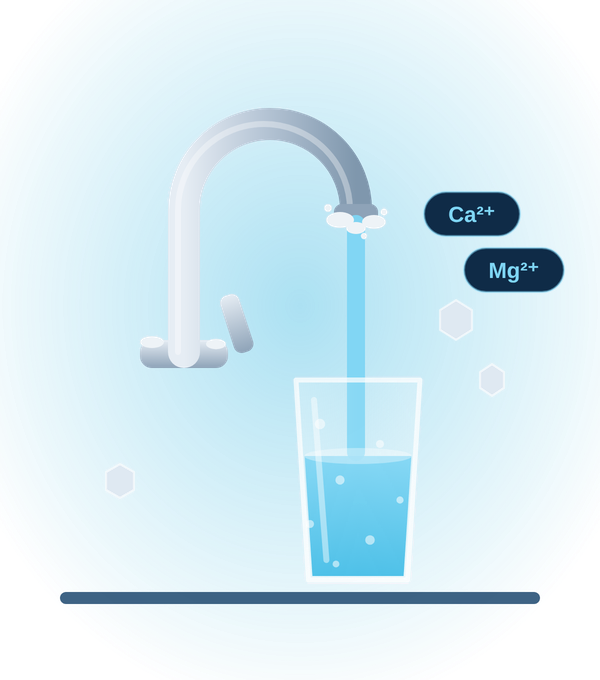
Hard water: scale on a faucet and spots on a glass — water softener, Portage MI

What "hard" water actually is

As groundwater moves through limestone and dolomite, it dissolves calcium (Ca2+) and magnesium (Mg2+). These are divalent cations — they carry a double positive charge, and that charge is the root of every problem below. We measure them in grains per gallon (gpg); one grain equals 17.1 milligrams per liter. By the U.S. Geological Survey classification, 121–180 mg/L as CaCO3 (about 7–10.5 gpg) is hard, and anything above that is very hard.1

Why hardness attacks your water heater first

Calcium carbonate has a property called inverse solubility2: unlike sugar or salt, it dissolves less as water gets hotter. So the moment your water is heated, dissolved calcium comes out of solution and deposits as hard scale on the element, the tank bottom and the heat exchanger. That scale is a poor conductor of heat, so it acts as an insulating blanket — the heater has to burn longer to push heat through it. The popping you hear is water flashing to steam beneath the scale layer.

The same chemistry explains soap scum. Soap is a fatty-acid salt; when it meets calcium, the two react to form calcium stearate — an insoluble curd that won't rinse away. That's the ring in the tub and the film on your skin. You're not using soap to get clean; you're spending most of it neutralizing minerals.

How a softener removes it: ion exchange

Ca2+ + 2 Na–Resin  →  Ca–Resin + 2 Na+ Service cycle: hardness is captured, sodium is released.

The tank is filled with sulfonated polystyrene resin beads, each carrying millions of negatively charged exchange sites loaded with sodium. Because the resin has a far higher affinity for divalent ions than for monovalent ones3, it grabs calcium and magnesium and releases sodium in their place. When every site is occupied, a concentrated salt brine floods the bed — the sheer concentration of sodium reverses the reaction by mass action, stripping the hardness off and flushing it to drain. That is regeneration; capacity is rated in grains removed per cubic foot of resin.

Why we recommend a TWIN TANK system

  • No hardness breakthrough. A single-tank unit has nothing in service while it regenerates, so the house receives raw hard water for that period. A twin tank switches instantly to a fully charged second tank — soft water is never interrupted.
  • Metered to true exhaustion. A single tank must hold back a reserve and regenerate early, guessing at tomorrow's use. A twin tank runs each bed to its full measured capacity because a spare is always standing by, so it regenerates fewer times per year for the same water treated.
  • Higher salt efficiency. Salt efficiency — grains removed per pound of salt — actually improves at lower brine dosages, but low-dose regeneration yields less capacity per cycle. Only a twin tank can afford to run there, which is why it uses measurably less salt and less rinse water.
  • Soft water for regeneration. Each tank is rinsed with softened water from its partner, so the bed is cleaned more completely and lasts longer.
Sources
  1. U.S. Geological Survey, Water Science School. Hardness of Water. Classification in mg/L as CaCO3; 1 grain per gallon = 17.1 mg/L.
  2. Snoeyink, V.L. & Jenkins, D. Water Chemistry. Wiley, 1980. Calcium carbonate solubility decreases with increasing temperature, driving scale formation in heated water.
  3. Helfferich, F. Ion Exchange. McGraw-Hill, 1962. Divalent-over-monovalent selectivity and mass-action reversal during brine regeneration.
Iron, sulfur & odor

High Iron & Why We Recommend an Iron Breaker

Oxidation alone isn't enough — here's the part that matters
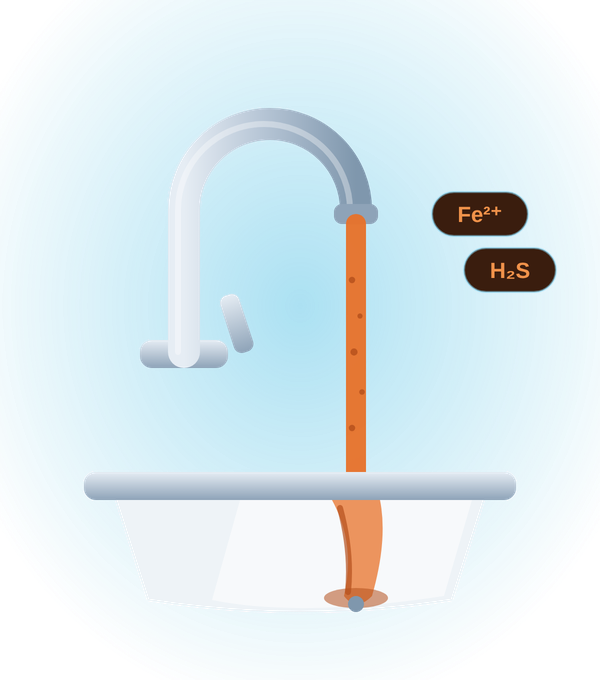
Iron in well water: rust-orange stream staining a sink — Iron Breaker iron filter, Kalamazoo MI

Two kinds of iron, and why it matters

Deep groundwater carries almost no dissolved oxygen, so iron exists there as ferrous iron (Fe2+) — fully dissolved and completely invisible. That's clear-water iron: the glass looks fine at the tap, then turns orange on the counter as air reaches it. Once oxygen is present, iron converts to ferric iron (Fe3+), which cannot stay in solution. That's red-water iron, the rust particles you can already see. Staining begins at just 0.3 ppm, the EPA National Secondary Drinking Water Regulation limit1; many wells in this area run 3 to 10 ppm or higher.

Why a softener alone fails on iron

A softener captures ferrous iron the same way it captures hardness, by ion exchange. The trouble starts the moment any oxygen reaches the resin bed — the captured iron oxidizes inside the beads and deposits as solid ferric hydroxide in the pore structure. That deposit is physical, not ionic, so brine cannot wash it out. Exchange sites are blinded, capacity falls, and the only remedy is aggressive chemical cleaning that shortens resin life further. A softener is engineered for hardness — asking it to carry the iron load is how a good softener dies young.

The Iron Breaker: ozone oxidation AND filtration, in one tank

2 Fe2+ + O3 + 5 H2O  →  2 Fe(OH)3↓ + O2 + 4 H+ Dissolved iron becomes filterable solid. Conversion is step one — not removal.
  • Step 1 — Ozone oxidizes it. An onboard generator produces ozone (O3) from ordinary air and injects it into the top of the tank. Ferrous iron reacts on contact and drops out as ferric hydroxide floc — visible rust particles.
  • Why ozone instead of plain air. Oxidizing strength is measured as electrode potential: oxygen sits at 1.23 volts, ozone at 2.07 — ozone is the strongest oxidant in practical water treatment.2 In practice that means three things. It works far faster and in a smaller tank. It stays effective at lower pH, where simple aeration slows to a crawl and often needs pH correction added first. And because ozone is a disinfectant, it kills the iron and sulfur bacteria that cause recurring slime and odor — air alone converts iron but leaves that bacteria alive in the system. Ozone then reverts to plain oxygen, leaving no chemical residual in your water.
  • Step 2 — The media bed captures it. Below the injection zone sits a bed of filtration media that both catalyzes further oxidation on its surface and physically traps the floc. This is the step that actually removes iron from your water. Without it, you have only converted invisible iron into rust and sent it downstream into your plumbing, fixtures and softener.
  • It handles sulfur and manganese too. The same oxidizing environment converts hydrogen sulfide (the rotten-egg gas) to elemental sulfur and manganese to insoluble manganese dioxide — both then caught by the same bed. Manganese in particular is stubborn: weaker oxidants struggle with it, ozone does not.
  • Step 3 — It cleans itself. On schedule the unit backwashes, reversing flow to expand the bed roughly 20–40%3, lifting the accumulated iron free and flushing it to drain. No chlorine to feed, no peroxide to mix, no pump to fail — the oxidizer is generated on demand from the air in your utility room.
Sources
  1. U.S. EPA. National Secondary Drinking Water Regulations, 40 CFR 143.3. Iron 0.3 mg/L; manganese 0.05 mg/L.
  2. Langlais, B., Reckhow, D.A. & Brink, D.R. (eds.). Ozone in Water Treatment: Application and Engineering. AWWA Research Foundation / Lewis Publishers, 1991. Standard oxidation potentials and oxidation of Fe(II), Mn(II) and sulfide.
  3. Edzwald, J.K. (ed.). Water Quality & Treatment: A Handbook on Drinking Water, 6th ed. AWWA / McGraw-Hill, 2011. Oxidation–filtration for iron and manganese; backwash bed-expansion criteria.
Tannins

Tannins & Why We Recommend Anion Exchange

Tea-colored water — and why the fix sometimes needs a second piece
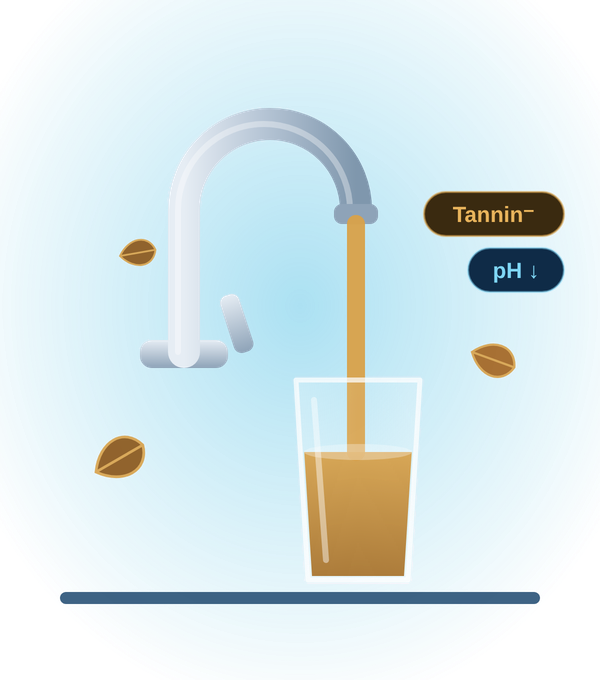
Tannins: tea-colored well water in a glass — anion exchange tannin filter

What tannins actually are

Tannins are natural organic matter — humic and fulvic acids leached from decaying leaves, peat and root systems as water moves through soil. They are not an industrial contaminant and not a health hazard — they are the same compounds that color a cup of tea. They show up most in shallow wells, wells near wetlands or wooded ground, and wells with surface influence.

What matters for treatment is their chemistry: tannins are weak organic acids, and at normal water pH they carry a negative charge. That single fact is why a softener does nothing for them. Softener resin is a cation exchanger — it is built to capture positively charged ions like calcium. A negatively charged molecule passes straight through, which is why a customer with a new softener still has yellow water.

How anion exchange removes them

R–Cl + Tannin−  →  R–Tannin + Cl− Strong-base anion resin trades a chloride ion for the tannin molecule.

The tank holds a strong-base anion (SBA) resin charged with chloride. Because tannin molecules are negatively charged, the resin's positively charged sites capture and hold them, releasing a harmless chloride ion in exchange. When the bed is loaded, salt brine regenerates it just as it does a softener — same salt, different resin, opposite job.1

Why this can make your water acidic — and how we prevent it

This is the part most companies don't explain, and it matters.

  • The resin takes more than tannins. It captures negatively charged ions generally — and the most abundant one in your water is bicarbonate (HCO3−), which is what alkalinity means. Alkalinity is your water's natural buffer: the thing that resists pH change.
  • Trading bicarbonate for chloride removes the buffer. Every bicarbonate ion the resin captures leaves behind a chloride ion, which has no buffering ability at all. With the buffer stripped out, dissolved carbon dioxide in the water is free to act as carbonic acid, and the pH falls. This is expected chemistry, not a malfunction.
  • Low pH is corrosive to plumbing. Acidic water attacks copper pipe and brass fittings — blue-green staining in sinks, a metallic taste, and eventually pinhole leaks. EPA's secondary standard for drinking water pH is 6.5 to 8.5 for exactly this reason.2
  • When it drops, calcite restores it. We test the treated water. If pH falls below 7.2, we add a calcite tank — crushed calcium carbonate. Acidic water passing through slowly dissolves it, consuming the acid and returning bicarbonate alkalinity and calcium to the water — CaCO3 + H+ → Ca2+ + HCO3−. It is self-limiting by design: calcite stops dissolving once the water reaches equilibrium near neutral, so it cannot overshoot and make your water alkaline.3 If your treated water holds above 7.2, you don't need it — and we won't sell it to you.
  • Why it has to be refillable. The media is consumed — it is sacrificial by nature, dissolving a little at a time to do its job. It is not a filter that backwashes clean; the bed slowly depletes and gets topped off on service. A neutralizer tank that never needs refilling is a neutralizer that stopped working.
Sources
  1. Bolto, B., Dixon, D., Eldridge, R., King, S. & Linge, K. "Removal of natural organic matter by ion exchange." Water Research 36, no. 20 (2002): 5057–5065.
  2. U.S. EPA. National Secondary Drinking Water Regulations, 40 CFR 143.3. pH 6.5–8.5; color 15 color units.
  3. Edzwald, J.K. (ed.). Water Quality & Treatment: A Handbook on Drinking Water, 6th ed. AWWA / McGraw-Hill, 2011. Anion exchange and alkalinity effects; calcite contactors for corrosion control.
Drinking water & PFAS

Drinking Water & Why We Recommend Reverse Osmosis

The last line of defense — including for contaminants nobody was testing for 20 years ago
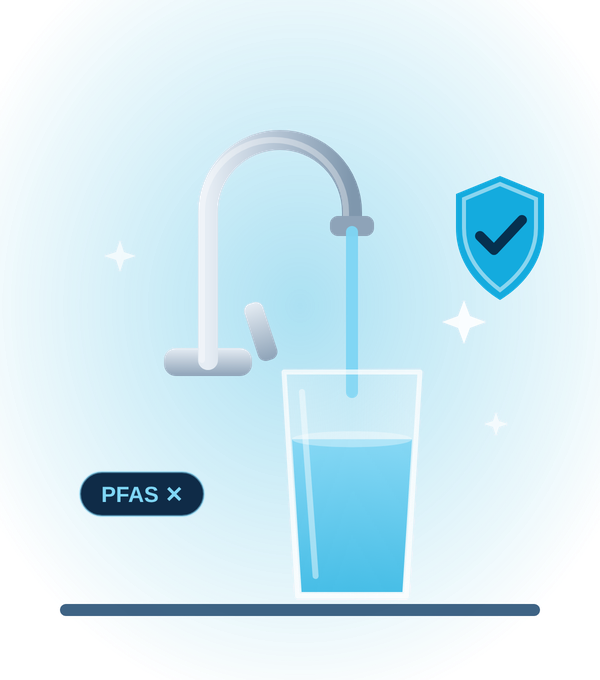
Clean drinking water from an under-sink reverse osmosis faucet — PFAS removal, NSF/ANSI 58

Why whole-house treatment isn't the whole job

A softener exchanges hardness ions. An iron filter oxidizes and traps metals. Neither is designed to remove the small, dissolved contaminants that matter most in the water you drink and cook with — lead from legacy plumbing, nitrate, arsenic, and the class of synthetic compounds now called emerging contaminants. That requires a different separation mechanism, installed at one faucet.

How reverse osmosis works

Left alone, osmosis drives water toward the more concentrated side of a membrane. Reverse osmosis applies feed pressure greater than that natural osmotic pressure and forces water the other way — through a thin-film composite polyamide membrane whose effective passages are on the order of 0.0001 micron (about 0.1 nanometer). Water molecules pass. Dissolved ions and larger organic molecules are rejected by a combination of size exclusion and charge repulsion, then carried continuously to drain in the concentrate stream rather than accumulating in a cartridge. Typical systems reject 95–99% of total dissolved solids.

The membrane is protected on both sides: a sediment filter and a carbon block come first — carbon is essential because free chlorine oxidizes and destroys polyamide film — and a final carbon polish follows the storage tank.

PFAS — the "forever chemicals" — and why RO is the answer

PFAS are built around a carbon–fluorine bond with a dissociation energy near 485 kJ/mol — the strongest single bond in organic chemistry.4 Nothing in the environment or in the body readily breaks it, which is why these compounds persist for decades and accumulate.

  • The regulated limit is 4 parts per trillion. EPA's 2024 national standard sets the MCL for PFOA and PFOS at 4.0 nanograms per liter.1 For scale: four drops of water in twenty Olympic swimming pools. It is undetectable by taste, smell or appearance.
  • RO is EPA-listed Best Available Technology. EPA's own technology assessment reports maximum PFOA and PFOS removal efficiencies greater than 99% — up to 99.9% for reverse osmosis, alongside granular activated carbon and ion exchange.2 Our under-sink system is NSF/ANSI 58 certified for PFOA/PFOS reduction. Full-scale monitoring across U.S. treatment plants found conventional treatment — coagulation, sedimentation, filtration, disinfection — removes essentially none.3
  • Private wells are outside the rule. The federal MCL applies to public water systems. No agency samples a private well unless the owner arranges it.
  • Even on municipal water, the clock has moved. EPA is extending the utility compliance deadline to 2031 and reconsidering the standards for several other PFAS compounds. Point-of-use treatment puts the decision at your own sink instead of on a regulatory schedule.
Sources
  1. U.S. EPA. PFAS National Primary Drinking Water Regulation. 89 Fed. Reg. 32532 (April 26, 2024). MCL 4.0 ng/L for PFOA and PFOS.
  2. U.S. EPA. Best Available Technologies and Small System Compliance Technologies for PFAS in Drinking Water (April 2024), EPA-815-R-24-006.
  3. Appleman, T.D. et al. "Treatment of poly- and perfluoroalkyl substances in U.S. full-scale water treatment systems." Water Research 51 (2014): 246–255.
  4. O'Hagan, D. "Understanding organofluorine chemistry: an introduction to the C–F bond." Chemical Society Reviews 37 (2008): 308–319.

Not sure which one you have?

Most wells have more than one. A free in-home water test tells us which — and how much.

Schedule a free water test

Or call (269) 262-1399

Schedule a Visit