You’re the one standing in the kitchen when the well test comes back or the buyer asks why the sink is orange. This page gives you the plain-English version of every common water problem, a guide to reading the test, and exactly what happens after you hand them our number. We test free, explain it simply, install it ourselves and service it for years.
Copy one into a text or an email, or send the link. Each one says what the problem is, what it means for the house, and what happens next. None of them is a sales pitch, which is why they work.
The water test shows hard water, which is normal for this area; nearly every home around here has it, city water included. Hardness is calcium and magnesium the water picked up from limestone on its way to the well. It isn't a health problem, but it leaves white scale on fixtures and inside the water heater, spots the dishes, and makes soap and detergent work poorly. For the house, that means a water softener sized to the hardness and the number of people living there. Clear & Simple Water Service tests at the house for free and installs it themselves: (269) 262-1399.
The water has iron in it, often with sulfur, which is the rotten-egg smell. Iron comes out of the well dissolved and invisible, then turns orange when it hits air, which is what stains the toilets, tubs and laundry. It isn't regulated as a health concern, only for staining and taste, but it is hard on fixtures and appliances and a plain softener won't keep up with it. For the house, that means an iron filter ahead of the softener. Clear & Simple Water Service installs an ozone iron filter that needs no chemicals, and services it: (269) 262-1399.
The well test shows nitrate above the federal limit of 10 mg/L (measured as nitrogen). Nitrate comes from fertilizer, manure and septic systems and moves with groundwater into shallow wells; you can't see, taste or smell it. The limit exists mainly to protect infants under six months and pregnancies, with longer-term concerns for adults. Boiling makes it worse, and softeners and carbon filters don't remove it. For the house, that means either a whole-home nitrate filter so every tap is under the limit, or a reverse osmosis system at the kitchen sink if drinking water is the only concern. Clear & Simple Water Service sizes the system from the lab number, installs it, and retests to confirm: (269) 262-1399.
The yellow or tea color in the water is tannins, natural organic matter from leaves and peat that the well draws through. It isn't a health issue, but it stains laundry and fixtures and gets darker after heavy rain, and a softener or iron filter won't remove it. For the house, that means a tannin filter, which works like a softener with a different resin. Clear & Simple Water Service confirms it with a free test at the house and installs it: (269) 262-1399.
PFAS are man-made chemicals from firefighting foam, nonstick coatings and industrial sites that have turned up in groundwater across Michigan. They have no taste or smell, a private well isn't tested for them unless the owner arranges it, and a softener or iron filter doesn't remove them. For the house, that means a reverse osmosis system under the kitchen sink, certified to NSF/ANSI 58, which removes PFAS along with lead, nitrate and most other dissolved contaminants from the water the family drinks and cooks with. Clear & Simple Water Service installs it and changes the filters once a year: (269) 262-1399.
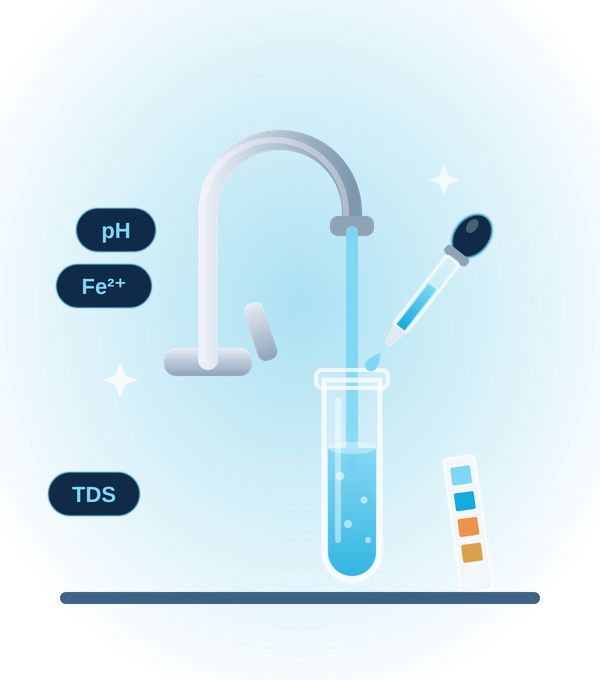
Before anyone talks about equipment, Clear & Simple Water Service comes to the house and tests the water at the kitchen table: hardness, iron, pH, TDS and a nitrate strip. It is free, there is no obligation, and the owner explains the results in plain English. If the water is fine, he says so and leaves. If it needs something, you get a real price from the person who would do the work. (269) 262-1399.
Lab reports look different from one lab to the next, but the same handful of lines decide what a house needs. Send us the report and we read the whole thing with you.
| Test | Units | Where the line is | What it means for the house |
|---|---|---|---|
| Hardness | mg/L (ppm) as CaCO3, or grains per gallon. 17.1 mg/L = 1 gpg. | Above 7 gpg (120 mg/L) is hard; above 10.5 gpg (180 mg/L) is very hard. Most local wells, and Kalamazoo city water, are well past that. | Softener. The number sets the size; the household sets the rest. |
| Iron | mg/L, the same as ppm. | Staining starts at 0.3 mg/L, the EPA secondary standard. Many local wells run 1 to 5. | Iron filter ahead of the softener. Sulfur odor usually travels with it and is rarely on the lab report; the nose finds it at the tap. |
| Nitrate | mg/L as N (nitrogen) or as NO3 (nitrate). 10 as N is the same as about 45 as NO3. | Federal limit 10 mg/L as N. Check the unit line before you compare. | Over the limit: whole-home nitrate filter, or reverse osmosis at the kitchen sink. Under it with an infant on the way: often treated anyway. Nitrite has its own limit, 1 mg/L as N; the same two systems remove it. |
| pH | pH units. | 6.5 to 8.5 is the EPA secondary range. | Below 7 the water can corrode copper (blue-green stains, pinhole leaks) and it changes how iron and tannin treatment are set up. That part is ours. |
| TDS | mg/L, total dissolved solids. | 500 mg/L secondary standard. | The before-and-after number for reverse osmosis, which removes about 98% of it at the drinking tap. |
| Tannins / color | Color units, or a note that tannins are present. | Any visible yellow or tea tint. | Tannin filter. A staining and appearance problem, not a health one. |
| Coliform bacteria | Present or absent. | Any “present” result. | Not a filter problem. The well needs to be disinfected and retested, which is well-contractor work; we will say so and point you to the right people. |
| Lead, arsenic, others | µg/L, the same as ppb. | Lead action level 15 µg/L; arsenic limit 10 µg/L. | Lead in a private well usually comes from the plumbing, not the aquifer. Reverse osmosis at the kitchen tap handles both for drinking water. If a report shows something bigger, we tell you straight. |
Where the numbers usually come from: VA and USDA loans on a home with a private well require a water test, and FHA lenders often ask for one. Coliform bacteria, nitrate and nitrite are the standard set, with lead often added. That lender test is where most nitrate numbers first surface, usually a few weeks before closing. The Kalamazoo County Health Department also tests private wells.
Well water in a new build is a question until the well is in and the water has been tested. We take that question off your list: one visit to test, one quote for whatever the water needs, one install coordinated with your plumber, and then every water call for the life of the system comes to us, not to you.
Quoted to you or to the buyer, whichever the build calls for. Either way the homeowner gets our number and the warranty: 5 years on the Clack WS1 valve, 10 years on the tank.
A softener on an easy well can go years without attention. An iron filter on a tough well can’t: it needs its settings checked, its performance watched, and someone who knows what the numbers mean when they move. That is the difference between a system that works for fifteen years and one that gets pulled out in three. We are the ones who show up for that part, which is why the homeowner’s water calls stop coming to you.
Or to type into a text. Change the names, keep the promise: free test at the house, plain English, the owner does the work.
Yes. Ask them to mention your name so we know where the referral came from, and with their OK we keep you posted on where things stand.
The number and its unit are enough to quote. The full report helps us read the rest of the picture (hardness, iron, pH) so the first visit covers everything at once.
We say so and leave. Your client still gets the test results in plain English, and your name is on the referral, so we treat it that way.
Tell us the closing or move-in date up front. We schedule around inspections and closings whenever the calendar allows, and we put the retest result in writing for the file.
Whichever the build calls for. Either way the homeowner gets our number, the warranty (5 years on the Clack WS1 valve, 10 on the tank) and the service book, so the water calls after closing come to us.
Email the report or call with the number. We take it from there and keep you in the loop.
Based in Portage. Serving Portage, Kalamazoo, Vicksburg, Schoolcraft, Mattawan and Southwest Michigan.