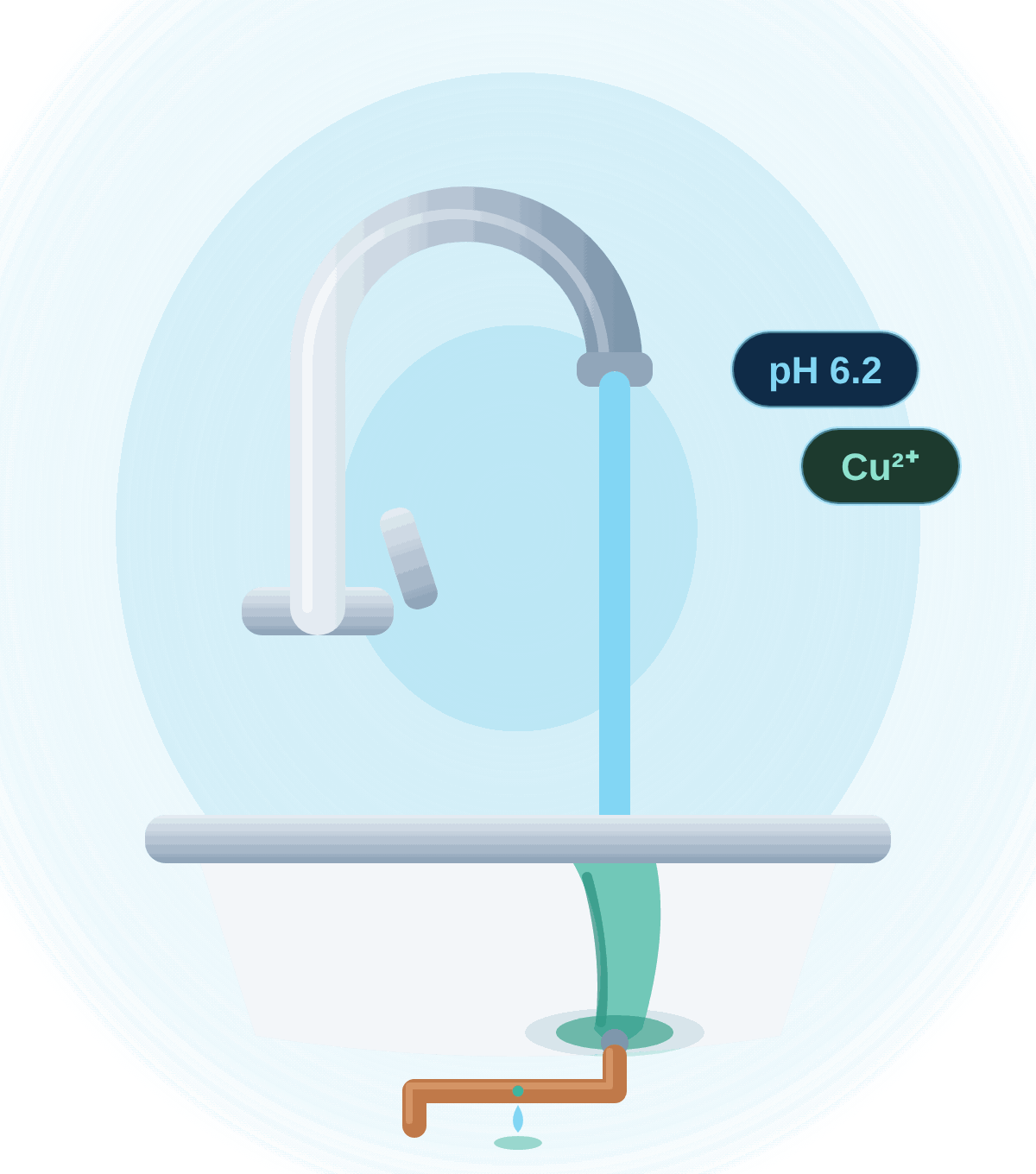
Blue-green stains in the sink, a metallic taste, a pinhole leak in copper pipe? That’s low pH, and the water itself looks fine. A calcite neutralizer raises it to neutral by dissolving a little crushed calcium carbonate as the water passes, with no drain, no power and nothing to program. We test the pH before and after, and top up the calcite on service, because it is meant to be used up.
In short
Well water turns acidic when it carries dissolved carbon dioxide and too little natural alkalinity to buffer it, which is common in shallow wells and sandy ground. A tannin or dual media system can do the same thing on purpose, by stripping alkalinity along with the tannins. The water is not unhealthy in itself; the problem is that it dissolves copper and brass on the way to your tap, and EPA’s secondary range of 6.5 to 8.5 exists to protect the plumbing.
The science sheet says what a fix has to do. This is how ours does it
The in-home test (pH, alkalinity, hardness, iron), a tank sized to your flow, installation with a bypass, the first fill of calcite, start-up, a walkthrough, and a before-and-after pH result in writing.
The blue-green staining stops spreading, and once the old stains are cleaned they stay gone. The metallic taste goes with them. Out of sight, copper stops dissolving, so new pinhole leaks stop starting.
Plain calcite covers raw water down to about pH 6.0. Lower than that, or very high flow, means a stronger media blend and a bigger tank, and we talk that through before anything is sold.
A standard tank, an in-and-out head and a bag of calcite: the only part that wears is the media, and it is refilled through the port by the person who installed it.
| Media | Calcite, NSF/ANSI 60 |
| Tank | 10×54 in., ported for refilling |
| Media volume | About 1.5 cu ft |
| Flow path | Upflow; no backwash or drain |
| Service flow | Up to about 7 gpm |
| Raw water pH | About 6.0 to 6.9 |
| Treated pH | About 7.0 to 7.5, self-limiting |
| Plumbing | 3/4" or 1" connection |
| Warranty | 10 years tank |
Installed in Portage, Kalamazoo, Vicksburg, Schoolcraft, Mattawan, Paw Paw and across Southwest Michigan.
The pH reading on the free in-home test, which we run on every visit. The house usually tells you first: blue-green stains around drains and in tubs, a metallic taste, or a pinhole leak in copper pipe. Treated water after a tannin filter gets tested too, because that is where pH drops.
No. Calcite dissolves only while the water is acidic and stops as it approaches neutral, so the treated water settles around 7.0 to 7.5 on its own. That self-limiting chemistry is why we use plain calcite for most wells and reserve faster magnesium oxide blends for water below pH 6.0, where someone has to watch the result.
Water enters at the bottom of the tank and flows up through the calcite, which keeps the bed loose and in full contact without a backwash cycle. No drain line, no electricity, no settings to drift. The only part that wears is the media.
A typical household dissolves roughly 50 to 100 lbs a year, depending on pH and how much water you use. We check the level at the annual check-up and top it up through the port on the tank in a few minutes, so you never handle it unless you want to.
A little. Every grain of calcite that dissolves adds calcium, usually a few grains per gallon. If you have a softener, the neutralizer goes ahead of it and the softener takes that hardness back out. Without one, expect slightly harder water than before, which is the trade for pipes that stop dissolving.
Ahead of the softener when the well itself is acidic. After a tannin filter or dual media system when the treatment is what lowered the pH, since that is where the water is most acidic. We set the order from your test.
10 years on the tank. There is no valve to warrant; the in-and-out head has no moving parts.
We test hardness, iron, pH and TDS at your house and tell you what, if anything, your water needs.
Schedule a free water testOr call (269) 262-1399